

I'm writing a book - the concept
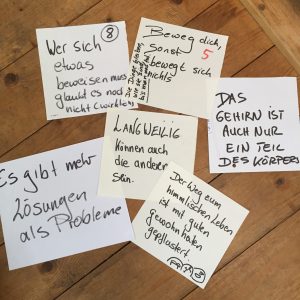 If you know what you want to write about - in my case the life-giving sentences that I have discovered over the course of 50 years - the question of how to put it all together and compose it is still important. This is definitely an art - much like composing a piece of music that lives from even bars but also dramatic climaxes.
Incidentally, the breaks don't just apply to the text, but also to the writing process. I only wrote for about two or three hours most days - because the brain also needs time to do nothing or to do other things after intensive, creative phases.
Design frame
It is important to me to give the reader a clear, stable framework to guide them - the content can then be lively, colourful and inspiring.
So I sat down and wrote down all the sentences that are important to me. And asked my friends which good sentences they often hear from me. Sometimes I had to laugh - like when my graphic designer said which of my sentences had made the biggest impression on him and massively reduced stress: What works, works. What doesn't work, doesn't work!
 Individual sentences do not make a successful composition - an organising principle is required. I chose SWING, a concept I developed for full-life balance (I don't like work-life balance at all because it indirectly conveys that work is in opposition to life. I feel differently. Work can be a wonderful part of life).
I then assigned the sentences to the individual chapters. I only use about 3/4 of the available space - the rest develops by itself.
I actually did most of my work with paper in my hand. As much as I love writing on a laptop and letting my fingers dart over the keys, I also realise that a computer reduces thinking to a square box. That's not conducive to creativity.
Thinking with PC and paper
Inspired by Kreativitätsmensch Austin Kleon and the method of Design thinking I deliberately planned with pen and paper - Kleon goes so far as to have two different desks. One for the PC, the other for everything his brain needs to be creative. Pens, paper, modelling clay, glue, scissors and a large wastepaper basket for all those initial ideas that don't turn out so good after all.
One example:
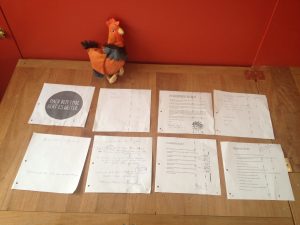 At the end of the process, there were still four pages left. This was because, for technical reasons, the number of book pages must always be divisible by 16 or 8 - there are usually 8 or 16 pages on a printed sheet. Michael Zimmermann, who was preparing the book for printing, asked me: What do you want to put on the four new pages? I sat in front of the PC and for the life of me I couldn't think of anything sensible.
My brain only started moving when I printed out the pages. And then noted down on white sheets of paper what would be good to fill the spaces between the pages with. I moved the sheets back and forth, scribbled and added - until I was satisfied with the result.
Then I finalised the content on the PC and sat back, satisfied with the result. And even Heinz the cockerel, my companion in good times and bad, seems to be satisfied.


