

Ship, sacrificial anodes and Easter
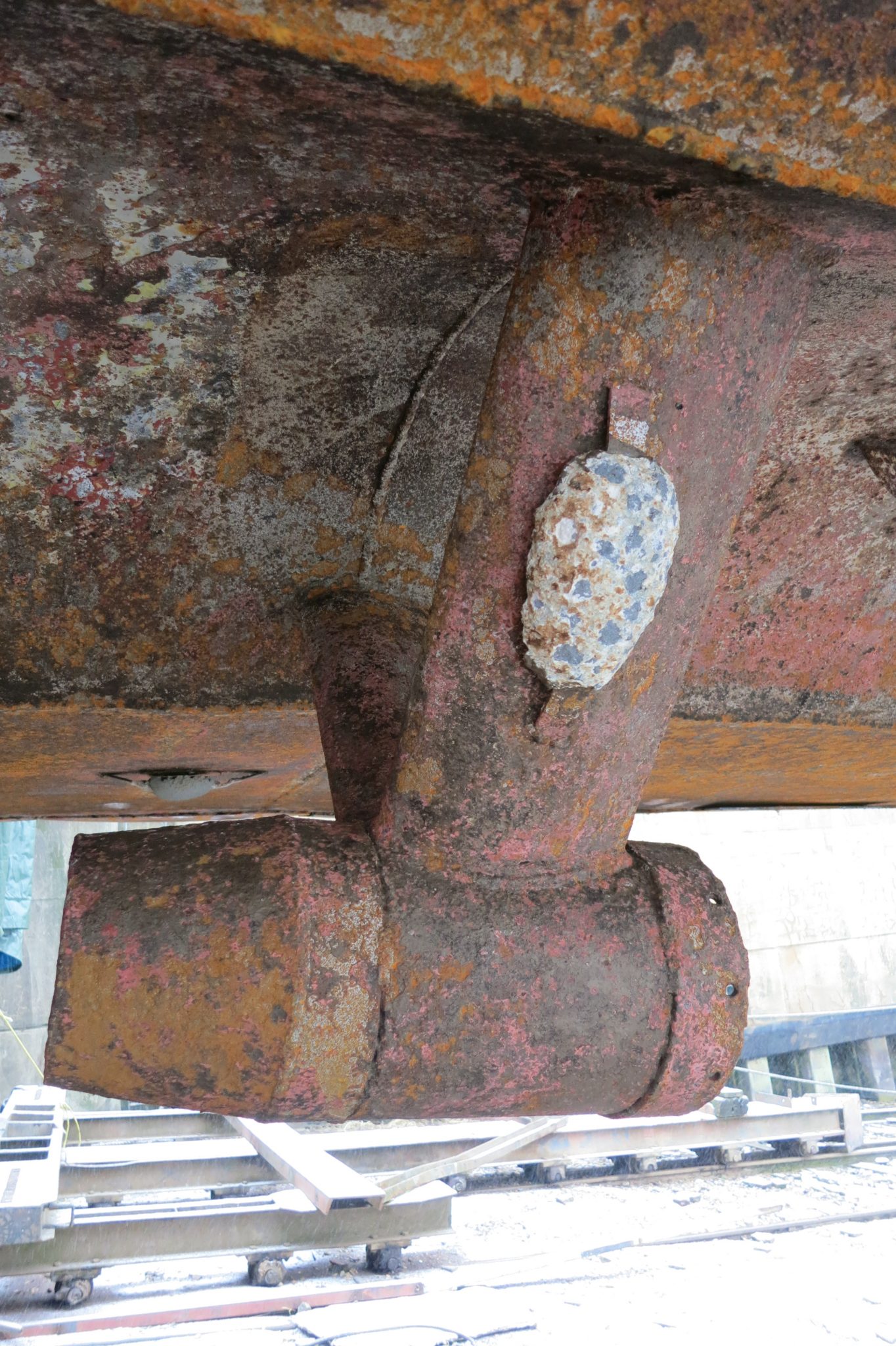 The ship has been welded, everything is tight, we just have to paint the underbody and then the shipyard work will be finished. Unfortunately, we can't paint in this cold and wet weather, so we're taking a break now. A good opportunity to explain some background.
The ship is made of steel. The water in contact with iron creates a galvanic cell ( battery ) whereby the oxygen in contact with the iron has a corrosive effect and the steel then corrodes and rusts. The contact of the steel with the water alone leads to this, because steel and water are not compatible in principle. Sooner or later, the steel will break down.
To prevent this, so-called sacrificial anodes are attached to the ship. In simple terms, these are lumps of inferior metal. As the name suggests, they sacrifice themselves. They are the first to be eaten away, leaving the steel of the ship protected.
The sacrificial anodes are usually made of zinc for ships in seawater and magnesium for ships in freshwater areas. Magnesium anodes can also be used in brackish water. They offer full protection, but degrade more quickly than zinc anodes.
The sacrificial anodes (the grey lump in the picture above) are attached to the outer wall of the ship every few metres. To ensure that the voltage is conducted to the sacrificial anodes, the ship is also painted with a conductive paint containing metal (underwater paint).
A few things went wrong with my boat. Some anodes were probably replaced during the last major visit to the shipyard. Only some heroes have fitted the ship with a mixture of zinc and magnesium anodes. They cancel each other out. In addition, the ship was not painted with conductive paint containing metal. The result: the corrosion process was able to take place in full swing.
In the rear part of the ship (stern), which is usually more and more damaged anyway, the steel was pretty broken. Some of it was only a millimetre thin or completely rusted - holes had broken out just from being hosed down at the shipyard. The stern was the area that was not accessible during the pre-purchase inspection. As the steel in other areas was good to very good, we were really surprised by the extent of the damage, which was not to be expected.
Now everything is welded. The ship will soon be painted underwater. This is a 3-layer coating. A conductive primer (first layer), then paint and then antifouling, which prevents mussels and algae from attaching to the boat. Then new, good sacrificial anodes are put on the boat. Then it's Easter....
Also in a symbolic sense. For me, the renovation of the ship has become an interesting parable for life. We all sail our ship of life through sometimes rough, sometimes stormy waves. Every now and then we spring a leak when we hit icebergs or rocks. But these major disasters are rather rare.
It is much more common for our steel skin to be attacked by internal tensions. We are energised. And if we don't dissipate it well, it eats away at us. Sooner or later.
There is someone who offers himself as a sacrificial anode: I'm there, deflecting the stress, the pain, the frustration, the anger for you. But we throw the sacrificial anode overboard, thinking we can do it on our own... until our steel is attacked or eaten away and, in the worst case scenario, we leak.
Redemption is called....da offers to repair the damage caused by the rejection of the sacrificial anodes. This can be painful. It involves cutting, sanding, hammering and welding until the ship is ready to sail again.
Easter means: I am given a new beginning. The opportunity to be lovingly and protectively enveloped by the Holy Spirit (new colour).... and the opportunity to release pain and tension to the Saviour (operanode). And to set sail again with a good captain and a new shipowner.
 For anyone who wants to understand this more deeply: I know a brilliant book that explains the exchange that happened at Easter - what we get rid of and what we get in return. The Quadro from Rosemarie Stresemann: In covenant with God.


Some of your statements about the function and mode of operation of the sacrificial anodes are not quite correct. Let's start with the mundane things: Sacrificial anodes cannot protect surface areas. They are designed to protect the steel from galvanic corrosion in the event of minor damage to the corrosion protection layer, especially in areas where higher-value elements (bronze propellers, brass thru-hulls, etc.) are nearby. For this reason, anodes are increasingly being fitted to hulls above the propeller and next to onboard diffusers. The number, weight and arrangement of the anodes are specified in the GL guidelines for cathodic corrosion protection - as is the material. If magnesium and zinc anodes are mixed, the magnesium anodes protect the zinc anodes. Zinc is higher in the voltage series and therefore cannot sacrifice itself for magnesium. Incidentally, magnesium is not approved by GL as an anode material, and reputable manufacturers of anodes (e.g. MGDuff) also point out that magnesium anodes should not be used if possible. Aluminium anodes can be used in brackish and fresh water. If the corrosion of the hull plating has actually progressed as quickly and as far as you have described, I would look for another cause, e.g. faults in the on-board electrical system, such as improper earthing. It's also news to me that the primer or undercoat is supposed to be conductive. Zinc dust or zinc phosphate is usually used for this - zinc dust on blasted surfaces - but the corrosion protection effect is also due to the position of the zinc in the voltage series - the conductivity is only a by-product. Otherwise, copper could also be painted directly onto the steel, killing two birds with one stone - but the result would be disastrous. The further coating of the underwater hull is primarily intended to prevent water from reaching the steel. For this reason, well-sealing paints such as tar epoxy (which may only be applied by specialised companies in Germany) are often applied in 3 to 4 coats. Only then is the antifouling applied, preferably without copper. To ensure that the story lasts longer than one to two years, the steel should be sandblasted after SA 2 1/2. Mechanical rust removal - i.e. sanding or brushing - is significantly more expensive, as the entire colour structure has to be completely renewed after a few years - even with professionally applied sacrificial anodes.
WOW!!! Thanks for the explanation!