

Ship - where we are and where the journey is taking us.
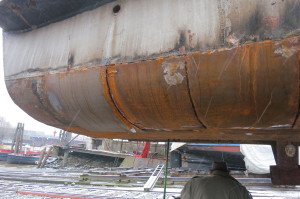
This morning I paid the last instalment for the purchase of the boat. A good feeling. It is now 100% mine. And „only“ needs to be finished.
Current status
We used pumps, hoovers and dry blowers to remove the water that got in during the flooding. That took a lot of extra time. But at least there was no frost damage while we were still full of water - burst steel due to frost would have been a mega disaster.
Unfortunately, when we checked the steel under the tanks, we discovered that it was still too thin over a few square metres. The bad news is that these will have to be expensively repaired or replaced with new steel plates. The good news: then all the steel on the ship will be fine!
What happens now
Karl, the boat builder, wrote to me yesterday to tell me roughly what the next steps are.
Work at the shipyard - in the next few weeks - basic refurbishment
- The Steel work must be completed. Cleaning the tanks and repairing the areas where the steel is too thin.
- Then come new Fan (so that nothing explodes) and new extractors for the heating oil. Then the tanks are sealed and closed.
- Then the Welded tanks and the bulkhead between the seminar room and the machine room is sealed (the water had entered the seminar room through the opening).
- Underbody coating, so that the ship is protected and beautiful.
- Insulation. Now we need insulation boards and wooden battens - that's what you insulate with. We paint underneath, then the insulation, then the wooden formwork. Then the wooden panels for the walls.
- Then we need 2000 litres of heating oil - Not for heating at first, but mainly as ballast in the right place, because otherwise the ship would be top-heavy and could tip over. Then, with the stones, the existing lead and the heating oil, we have 2500 kg of ballast in the right place. That's enough to get us safely back to the mooring.
This work is essential. A shipbuilder friend of mine, whose grandad was also a skipper, told me that his captain's grandad always slept with one leg on the floor and only one leg in bed... so that he would quickly realise if the ship was leaking. That happened to him twice. I prefer to sleep relaxed and allow my guests to sleep relaxed too, which is why we make sure everything is absolutely safe - even if it costs more at first.
Further shell construction
- Then the Machine room and seminar room painted and the steel inside cleaned and derusted.
- Then the seminar room and the insulation in the machine room - as in the already largely completed bedrooms
- Then the Floor in both rooms
- Then the Round floor area boarded with wood and the wall with wooden panels screwed in at porthole height. [ The round floor is at the bottom wherever you can't put a straight wall, because the ship tapers towards the keel - this goes right over the waterline, where the green insulation boards also end). Wall panelling made of tongue and groove timber planks is installed there. This is then painted white. Then it's finished. Pressed chipboard is placed over the top up to the portholes - these are then straight. You can also hang a picture there or screw something in.
- Then the Electrics. Runs along the ceiling in the lower ship. If the ship should leak, there is no power problem - pumps and lights continue to work. There are no short circuits. [Note to landlubbers: Dramatic water ingress á la iceberg and Titanic are rather rare. However, small leaks through which water can penetrate can happen - but can usually be repaired quickly].
- If the walls are under the windows in the seminar room, the floor is in there and in the engine compartment too, and the round floors are boarded with wood...then Summer
By that time, the seminar room will probably already be ready and the first seminars on board can take place - even if the rooms for overnight stays have not yet been finalised.
Interior fittings
- Then below comes the Sanitary: Guest loo and toilet in the private area, showers for guests and private.
- Then the Water boiler and the water tanks for black and white water and everything that goes with water, the pipes for the kitchen etc. etc.
- Immediately afterwards or shortly before - comes the already existing Oil central heating onto the ship and is connected.
- Then the shell is finished with water, plumbing and heating. Then Autumn.
- Because it is in the Winter is then warm and dry and theoretically habitable, we will then finish off all the blankets in winter.
- Then there are actually only the real Böden on it, the Walls are cancelled... and then it's christmas
Personnel requirements
The planning is based on Karl doing most of the work on his own and occasionally having people help - with or without previous manual skills. Everything simply goes faster if two or more people help out - one holds the panels, for example, and the other screws them together. You don't have to be a professional - although professionals such as welders, electricians, carpenters and plumbers etc. are of course very welcome. Just get in touch if you would like to help out for a few hours, days or weeks.
Material requirements
We will need a lot of material over the next few months. In order to keep the costs down, we would be grateful if we could get hold of one or two items more cheaply. If you can get hold of one or two items cheaply or even give them away or perhaps want to cover the costs for a material item, please let me know.
- Lead (as ballast)
- Fireplaces + chimney pipes (or „buller stoves")
- Sanitary requirements (washbasin, bathtub, toilet)
- Generators
- 2 Domestic waterworks
- Tanks for fresh and process water
- Holding tank
- Wood + wood screws
- Insulation boards
- Floorboards
- Glue
- Floorboards
- Tiles
- Insulating board
- Glass wool
- Paintbrush
- Firewood for the fireplaces
I am looking forward to the next steps and above all to the days


Congratulations on owning a ship!!! :-))
May all your dreams come true!
Wow, that's a good overview of the steps taken this year. Respect!