

Full in the wind - the book from the men's coach
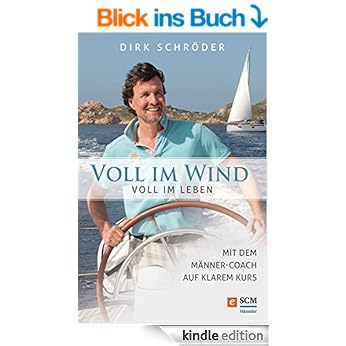 A perfect Sunday is when I have some time to read in addition to meeting people and enjoying nature. Last Sunday was such a day. From my „I would like to read" pile I pulled Full in the wind. Full of life. On course with the men's coach. By Dirk Schröer. I wanted to read it because I have been in contact - virtually - with the author from time to time. And, of course, because his topic of living one's own life to the full is also close to my heart. Because I „know“ him, I preferred to write my thoughts on the book in personal form - directly to him.
**************************************************************************************
Dear Dirk,
Congratulations on your first book!
Sunday was the day - I tore the plastic film off your book (the environmentalist in me hopes that if it has to be plastic, it's hopefully at least compostable) and started reading your book...and then continued reading it on the sofa, in the park and on the train. Since I know you at least a little, I didn't want to write a normal review, but rather personal comments from the various „voices“ in me that have spoken out about your book. And at the end I have a request....
The publisher
As I often do, I first leafed through the pages and read across. When I liked what I found, I read your book „properly“. That's quite a compliment, many books don't make it past this first hurdle for me...
The first impression is right. Good design. Pleasant feel. Good typeface (occasionally a paragraph more would have been good for readability). Beautiful fonts. Powerful images. Good design. Good overall composition. As a publisher, I know that behind a book there is a whole team of graphic designers, editors, producers, printers, etc. in addition to the author. You did a good job!
The author
I like the mixture of gripping stories and explanatory texts. The texts are easy to read and clear. And the stories are powerful. You (or woman) go with them inside, are taken along, go with them. When I read how Urs took the plunge into the deep end, I had tears in my eyes, I was so happy for him. You take the reader on a journey.
You also make it clear right at the beginning where the journey is heading: „I want to bring out what God has given every man as his very own talent. Together with the men, I want to discover their purpose and encourage them to set out to live the life they long for and for which they were created.“
The coaching colleague
You not only awaken in your readers a longing for the life they were created for, but you also give them good pointers on how to find their way. Sometimes - for example with vocation - it was almost too much of a good thing for me...I was afraid it might overwhelm readers for whom this is all new territory. Overall, however, I found the questions and impulses for action to be very well chosen and explained.
Many of the tools are of course familiar to me from my own coaching practice - I found it exciting to discover how you use, incorporate and formulate them. I particularly liked the image of the five satellites that help you find your bearings: your own history, your deep longing, the risks (that you may have avoided so far), your (current) training (the current challenge), your own spirituality.
I found some of your suggestions for action really courageous - for example, the questions a man can ask his wife if he wants honest feedback from her. Like „What is it like to live with me?“ Wow. If a woman hears this as a genuine question to which she can and may give an honest answer, then there is a lot of power in it for honesty and positive change. Or perhaps the joy of hearing positive things that you didn't even know about before. A stark, powerful suggestion that I hope many readers will take up.
The woman
As a woman, I naturally read very carefully how you describe women in your book. The result: I find it very pleasant that you hardly talk about roles, but a lot about identities. In many places, I feel that we are stuck in fixed role models of „this is how a man or woman should be" and that this deprives us of the joy of living the life that suits us and of meeting each other with curiosity and genuine interest.
I stumbled at one point. You write - presumably based on Eldrege - that the two central questions in a man's life are:
- Am I the beloved son?
- Have I got it?
And that of a woman:
- Am I lovable?
- Will someone fight for me?
From my point of view, the two questions you mention for women are basically variants of one Question:
- Am I attractive / precious / valuable (this also includes fighting for us)?
It is a central and important question for us, which - like the man's question „Am I the beloved son?“ - is about value and acceptance.
But for the men in your book, there is also the question of agency, i.e. the capacity to master life: „Do I have what it takes?“ This question also includes active behaviour - what can I do to master life better? What is the best way to do things?.
I don't have this question for women. But of course we also often ask ourselves whether we are managing to master our lives. The question is existential - just like for you men. Even if we don't necessarily look for the answer in the same place. When men talk to each other, it's often about what they can do. We women talk a lot about relationships. Not just love relationships. But all of them. Our relationship with friends, colleagues. Children. Underneath it all is the question:
- Can I / Do I have the ability to create relationships? (to keep / to create)?
In my view, that is very important. You would give women more dignity if you didn't just allow them to ask „passive“ questions (Am I lovable? Will someone fight for me?), but also one that includes active behaviour. I'd like you to add that in the second edition (hopefully soon). That would make it more rounded.
What I also liked was how you describe what you do as a man and what you can do to strengthen and promote your wife's potential. The book is of course written for men first, but I would have found it exciting to learn what a woman can do to encourage a man's potential. A woman once told me that God showed her: „Your husband is like a tree. With every word of blessing and encouragement, you strengthen him.“
In my experience, many women want to strengthen their husbands but don't know what really makes men strong. They then inadvertently do the wrong thing - such as comforting him when he could do with encouragement. They comfort with „Poor you, that's really bad“, when perhaps a confident „You've already overcome so many things, I trust you to do the same!“ would be more empowering. Just like men, women can't read minds either - they need clues. I would have found a section on this exciting: How a woman can empower a man and how he can ask her for it.
The inspired
I love to help people realise their potential. One of my books is not called not for nothing: Jump. Into full life. As a woman who loves to nurture and unleash people's potential, I found your book simply powerful and strong. The examples were clearly related to the male world, but I find many of the topics you address just as relevant for women: Not denying yourself, taking responsibility, chasing your dreams, leaving something behind in the world. That's why I would definitely recommend your book to anyone who wants to „live life to the full“.
I wish you much success and many more editions!
Kerstin
 And now a request:

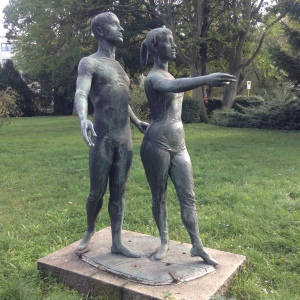
At one point you write: „In both cases, the partners of the respective heroes are not weak women, no princesses, who are passively waiting to be rescued. E are strong women. Because just like the man, of course, the woman should run in her strength!“ (p. 200) My heart rejoiced when I read this. Not least because I was quite irritated by the princesses mentioned several times on the previous pages.
I find the image of women as princesses problematic for various reasons.
- The princess-knight picture is from the medieval Minne culture. In those days, noblewomen had nothing else to do but be lovely and beautiful until the knight „conquered“ them. It came from a certain social class that others longed for because of the wealth associated with it. 95 % of people were not princesses and knights but peasants and merchants. And today there are perhaps 20 princesses and just as many princes in Europe. The rest are „others“. Of course everyone longs for a comfortable life of luxury without responsibility - but we're not really made for that.
- Calling a woman a princess turns her into a little girl. Prinzessinn trivialises women. Princesses are usually young, sweet, pretty and without any room for manoeuvre. In order to be able to shape anything herself, a princess has to passively wait until the king dies or a prince marries her. Calling a woman a princess ultimately turns her into a girl and keeps her small.
- If you have a princess for a wife, you make yourself small as a man. The husband of a princess is by definition at best a prince, not a king (or at worst a man who takes on the role of royal father to the cute princess - also horrible!) A prince is someone in a waiting position who has not yet been given his land. That's not a pleasant role. If you want to see how powerless it is to always be a prince, you only have to look at Prince Charles in England.
- Princesses don't suit you: You have a very healthy, powerful image of women and of partnership at eye level. Kristin, your wife - especially in your crisis - was not a princess waiting to be rescued. The cheesy, clichéd image of a princess doesn't match the clear, strong image you have of women and marriage and convey on every page of your book.
- The image of the princess is not biblical. Of course, I don't believe that you can only use images in books that are also used in the Bible. But nowhere in the Bible do I see God making women into princesses who are just waiting to be saved all the time and putting the burden on men to save the poor princess all the time. What stress!
There is one who Role of the saviour - for all princesses (which also includes men...you are also the bride of Christ) - that's enough. I can't imagine that it's a pleasure for a man to play this prince role all his life and constantly have to rescue the poor, dependent, weak princess. Rescuing a woman from a difficult situation from time to time as a man can be a gift for both of us. But as a permanent role function, it does not fit in with the fact that we as men and women are called to act together, to cultivate, to preserve.
The first biblical description of a woman in Genesis is Ezer, which literally means Hero, Saver or strong ally means - a word that God otherwise only uses to describe himself when he expresses that he is a powerful fighter at Israel's side in war situations. * And which is found in many biblical male names: Eliezer (God is powerful help). With the same words Ezer, powerful companion in war, God describes the woman....
[Some day in heaven, dear good Martin Luther, I would ask you how you came up with the idea of using this power word „Ezer“ with „Assistant“ when you yourself had such a powerful woman at your side? And a God who was also Ezer - a strong fortress, a powerful fighter for you, not just a „helper“ - you would never have called him that, would you]
Sons and daughters: Of course, we are sons or daughters - and therefore, as sons and daughters of the King of kings, also princes and princesses. Nevertheless, the image of princes and princesses is an image that the Bible does not use. Rather, we are described as kings and priests, co-rulers with Christ. We stand at his side as kings and queens. What dignity.
Biblical women are queens. From the beginning to the end of the Bible, we see one woman after another accepting the task of ruling over the land entrusted to her, either alone or alongside a man. The mother of Moses, Miriam, Deborah, Hannah, Abigail. Women who act powerfully. Strengthening and nourishing people. Even women in catastrophic situations - such as Ruth and Esther - still utilise their own scope for action. They are not just passively rescued by the hero. Instead, they use their room for manoeuvre for clear, strong actions and requests. And fortunately they meet equally strong men! Wow.
I love how a man describes his wife in Proverbs 31 - full of vigour and the ability to act. „Strength and dignity are her garment - and she laughs full of joy and confidence in the face of the next day!“ The woman of whom this is said is not a princess. She is a beautiful, well-dressed queen who runs her kingdom (family, company, agriculture) powerfully. And yet she is receptive to the warmth and appreciation of her husband.
You can tell that this is very close to my heart. Perhaps because it has been a long journey for me to develop myself out of the role of the little girl who expects everything from others. And with the encouragement of my encouraging God, to develop into a woman who knows and uses her room for manoeuvre.
I'm realising more and more that you don't have to be a helpless princess to enjoy the support of men or women. On the contrary. The more I realise the dignity and creative power with which Christ has endowed us - both men and women - the more I can enjoy it when God or a man gives me his strength to strengthen me in my life and my calling. Like a man who, in the ship that I am currently rebuilding, has drilled holes in the steel for the ventilation in a labour-intensive process. Marvellous! Or my God - the lover of my soul - who, when I was exhausted after a long, hard day, let me stumble into a wonderful classical music concert that made my soul blossom. Simply full of love!
I suspect that you want to emphasise the preciousness of women and the value they have with the princess image. Unfortunately, the image is rather unfortunate because it has so many overtones that weaken rather than strengthen women.
My request: Turn the princess into a queen. In my opinion, that suits you better, the way you see your own and other women and the way God intended men and women to be.
You are a man who shapes many men. The texts and images you use have an influence on others. Especially in communities, the princess and knight image holds many people captive. And many marriages don't even take place because people are so influenced by the image that they overlook the queen in their search for the princess or miss the man standing powerfully next to them in their expectation of the knight.
It would be great if in your seminars - and in a new edition of your book - you made the princess a queen. A woman who rules her kingdom with dignity and strength and stands next to and with a king who also rules his life. A marvellous power couple.
What is also important to me: A request is a request - nothing more and nothing less. If you would like to fulfil my request, I would of course love it. If you decide that you'd like to keep the princess, that won't change my appreciation of you in the slightest. For me, this is also part of dignity: asking openly and letting the other person make their own decisions.
You are a strong man who has a lot to give and gives a lot. And I appreciate the way you release and support men and women in their potential. Thank you for that. Keep up the good work.
************************************************************************************
Then I was curious to see Dirk's reaction. She was..... Enthusiastic. He wrote to me: “Please send me your phone number. After such a great email, I would like to thank you personally and finally hear your voice!“
We spoke on the phone for almost an hour on Tuesday and talked about what is important to us in terms of promoting men and women to their full potential. Right at the beginning he said: „What you write is absolutely right. If there's a new edition, then the princess will be queen. No question about it!“
And - now that we have already made the leap from virtual acquaintance to an acoustic one - there will be the first live meeting in November to get to know each other and brainstorm ideas for better, stronger cooperation between men and women.
I'm really looking forward to it!
Two more book tips to complement Dirk Schröder's book
For all those who want to live a relaxed and strong partnership at eye level:
 Harald and Hanna Sommerfeld: Living a relationship. Shaping a sustainable partnership. An experienced and relaxed couple talk about their relationship. Practical, true-to-life and very helpful.
For all those who still want to find a partner for life at eye level:
 Find a partner. Discover who suits me. A practical quadro (4 week training book) for all those who want to discover who they are, who suits them and how they can find him or her.
*Ezer in the Bible:
Genesis 2:18; Genesis 2:20; Exodus 18:4; Deuteronomy 33:7; Deuteronomy 33:26; Deuteronomy 33:2; Psalm 20:3; Psalm 33:20; Psalm 70:6; Psalm 89:20; Psalm 115:9; Psalm 115:10; Psalm 115:11.Deuteronomy 33:2; Psalm 20:3; Psalm 33:20; Psalm 70:6; Psalm 89:20; Psalm 115:9; Psalm 115:10; Psalm 115:11; Psalm 121:1; Psalm 121:2; Psalm 124:8; Psalm 146:5; Isaiah 30:5; Ezekiel 12:14; Daniel 11:34; Hosea 13:9


Super cool - and once again learnt a lot, thank you Kerstin!
Queen instead of princess - and then also king instead of servant - that makes sense !!!
Hello Kerstin,
I have no problem at all with „princess“ - especially when you realise that we are royal daughters...
This beautiful book by Gaby Wentland expresses what I mean.
http://www.amazon.de/meine-Prinzessin-Wentland-Ursula-Schulz/dp/3000291652
My image of princesses is not passivity at all... but has to do with beauty, cheerfulness, the daughter of a king, etc. Dynamic, youthful ...
Everyone probably associates different things with it.
Kind regards
Sibyl
I also see this positive aspect of „Princess“.
Hello Kerstin,
I notice that in fairy tales the princess becomes queen through „the marriage of the prince or king“, but in „real life“ it's more likely to be through succession and the coronation ceremony, isn't it?
I also associate „princess“ more with beauty, youthfulness, seduction ... see also „princess of the dawn“ ...
Greetings Jürgen
As I've spent a lot of time working with terminology, I can only agree that it's not helpful in this day and age to use a term to describe women that comes from a completely different era and is also characterised by fairy tales. A lot of childhood experience from that time also resonates.
The term „co-regents“ therefore fits better in our time. It is more sober, but emotionally clearer.
And ruling has to be learnt, and that is where our learning process with God begins: how can I rule well in life? In my own first