

I write a book - and find the right form
 As an author, it's in the nature of things that people tell me about their book ideas. Or what they think is a book project.
Sometimes, when I ask questions, I realise that the person I'm talking to has only used the most obvious form of publication in our culture - the book.
But a book is by no means always the best medium for what you want to say. There are many other good or even better options.
Digital media
- Apps: I would love to publish the questions I have collected as an app. That would be a very good way to utilise waiting times, to ask questions that help you to think outside the box - far better than a book.
- Online courses: I pass on a large part of my knowledge in Online courses, because I think the form - being challenged and inspired to progress once or twice a week - is very conducive to learning.
- Ebooks: They have the great advantage of minimising risk - there are no high printing costs. However, at least in Germany, 95% of people still prefer to read books in print. One publication that I currently receive the most feedback on is my free ebook Tidied up at last. Almost every reader has an "aha" moment when reading it, which makes tidying and decluttering much easier for him or her. I also have a more detailed Quadro on the topic Tidy written. But for many, the impulses from the e-book alone are a gift - and can be.
- Blogs: Quite clearly - the medium of choice if you want to communicate smaller units of inspiration to as many people as possible.
Paper-based media
- Newspapers and magazines: Publishing an article or a series of articles in a newspaper or magazine is also a great way to reach people with what is important to you. I usually use this for self-contained topics. We usually publish the articles that I have written for a magazine a few months after the magazine has been published - with permission - in our own Online magazine.
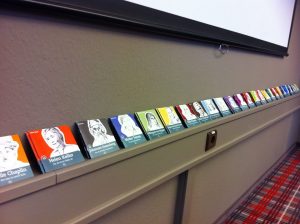 Compact formats: These are books of less than 100 pages that provide compact information on a topic. For us, these are the Impulse booklets, that summarise all the essentials on a topic in a really, really compact, pocket-sized format. I love them all, of course, but I particularly like the World changer series, because it presents influential personalities in a compact yet in-depth way. I really like this because I often don't have the time to read detailed biographies of all the people I find exciting.
- Training materials: If you want to teach people something, manuals, ring binders or exercise books are often a better choice than printed books. This has to do with the fact that bound books have to be printed in large numbers to make them economically viable. And it usually takes a long time before a reprint is made - if at all. We publish training materials in the stapled version. Quadro series. The 40-page booklets are ideal for familiarising yourself with the most important aspects of a topic. And the questions and suggestions for action lead straight into implementation.
- Illustrated books: Books and magazines that combine text and images into a beautiful whole are on the rise. Perhaps because people are longing for visual deceleration in a fast-paced, digital world.
What I decided in the end when I was told about my Anniversary project started dreaming, and why - I'll tell you all about it in the next post.

